Introduction
For many years, education has been centred around memorisation, learning answers, recalling facts, and reproducing information in exams. While this approach may help in scoring marks, it does not always prepare students for real-life challenges.
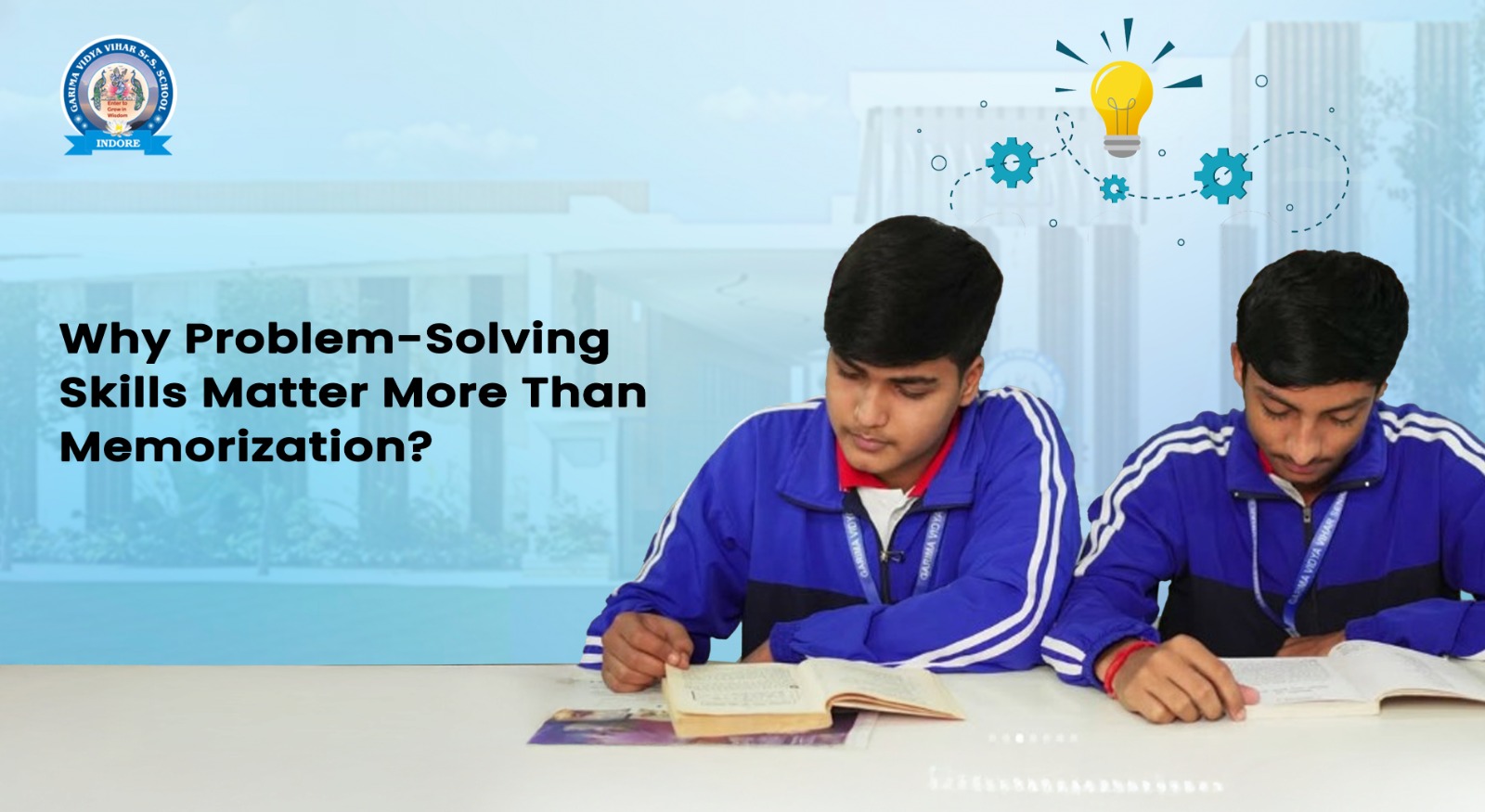
Today, the focus is gradually shifting towards something more meaningful, developing problem-solving skills for students. These skills help learners think independently, analyse situations, and find practical solutions, which are far more valuable in the long run.
Memorisation vs Understanding
Memorisation allows students to remember information temporarily, often just for exams. But once the test is over, much of that information fades away.
On the other hand, when students understand concepts and learn how to apply them, the knowledge stays with them. This is where problem-solving skills for students make a real difference. Instead of simply recalling answers, students learn how to approach questions logically and confidently. Why Problem-Solving Skills Matter?

Builds Independent Thinking
When students are encouraged to think for themselves, they become more confident in their abilities. They stop relying on fixed answers and start exploring different ways to approach a situation.
This independence is essential not just in academics, but in everyday decision-making.
Prepares Students for Real-Life Situations
Life rarely presents questions with direct answers. Whether it’s managing time, handling challenges, or making decisions, students need the ability to think on their feet.
Developing problem-solving skills for students ensures they are better prepared to face real-world situations with clarity and confidence.
Improves Academic Performance
Understanding how to solve problems helps students perform better across subjects. Instead of memorising formulas or definitions, they learn how and when to apply them.
This deeper understanding leads to stronger concepts and better results over time.
Encourages Creativity
Problem-solving is not just about finding the right answer, but also about finding different ways to reach it.
Students who develop this skill become more creative, open-minded, and willing to experiment with new ideas.
Reduces Fear of Failure
When learning is based only on memorisation, students often fear making mistakes. But when they focus on solving problems, mistakes become part of the learning process.
They begin to see challenges as opportunities rather than obstacles.
Also read: https://www.garimaschool.com/building-a-balanced-study-routine-during-exams/
Role of Schools in Developing Problem-Solving Skills
Schools play a key role in shifting learning from rote memorisation to understanding. Classrooms need to encourage questioning, discussions, and practical applications.
Activities like case studies, group tasks, real-life scenarios, and project-based learning help students develop problem-solving skills for students in a natural and engaging way.
How Garima Vidya Vihar Encourages Practical Learning?
At Garima Vidya Vihar, the focus is not limited to textbooks. The school believes in helping students understand concepts rather than just memorising them.
Teachers encourage students to ask questions, think critically, and participate actively in classroom discussions. Through interactive teaching methods, practical activities, and collaborative learning, students gradually build confidence in their thinking abilities.
This approach supports the development of problem-solving skills for students, ensuring they are ready for both academic success and real-life challenges.
Finding the Right Balance
Memorisation is not entirely unnecessary. It helps in learning basic facts and foundational knowledge. However, it should not be the only method of learning.
A balanced approach that combines understanding with application ensures that students not only know the answers but also understand how to reach them.
Conclusion
The future belongs to those who can think, adapt, and solve problems effectively. While memorisation may help in the short term, it is problem-solving that truly shapes a student’s ability to succeed in life.
By focusing on practical learning and encouraging curiosity, schools can help students become confident learners who are ready to face any challenge.
FAQs:
Q1. What are problem-solving skills?
Problem-solving skills are the ability to analyse a situation, think critically, and find effective solutions. They help students approach challenges confidently rather than relying on memorised answers.
Q2. Why are problem-solving skills more important than memorisation?
While memorisation helps recall facts, problem-solving teaches students to apply knowledge, think independently, and handle real-world situations, skills that last a lifetime.
Q3. How can schools help students develop problem-solving skills?
Schools can encourage practical learning through group activities, case studies, project-based tasks, and interactive discussions that allow students to think critically and creatively.
Q4. Can memorisation still be useful for students?
Yes, memorisation is useful for foundational knowledge, like basic formulas, definitions, and facts. However, it should be combined with problem-solving for deeper understanding and practical application.
Q5. How does Garima Vidya Vihar promote problem-solving in students?
Garima Vidya Vihar focuses on understanding over rote learning. Through interactive teaching, practical activities, and collaborative learning, students develop confidence, critical thinking, and real-life problem-solving abilities.